🎧 Prefer listening over reading? I recorded the entire article as a voice note. You'll find it in the VIP Kitchen Table section and on the TKT private podcast!
--
About a week ago, I was curious: What are women actually after, when they say they want to change? We are living, my friends, in the Great Ozempic Era. The culture is positively marinating in weight loss talk right now. So naturally, I got curious.
What would happen if I actually asked people to fill in that blank? Would "thin" win in a landslide? Or not?
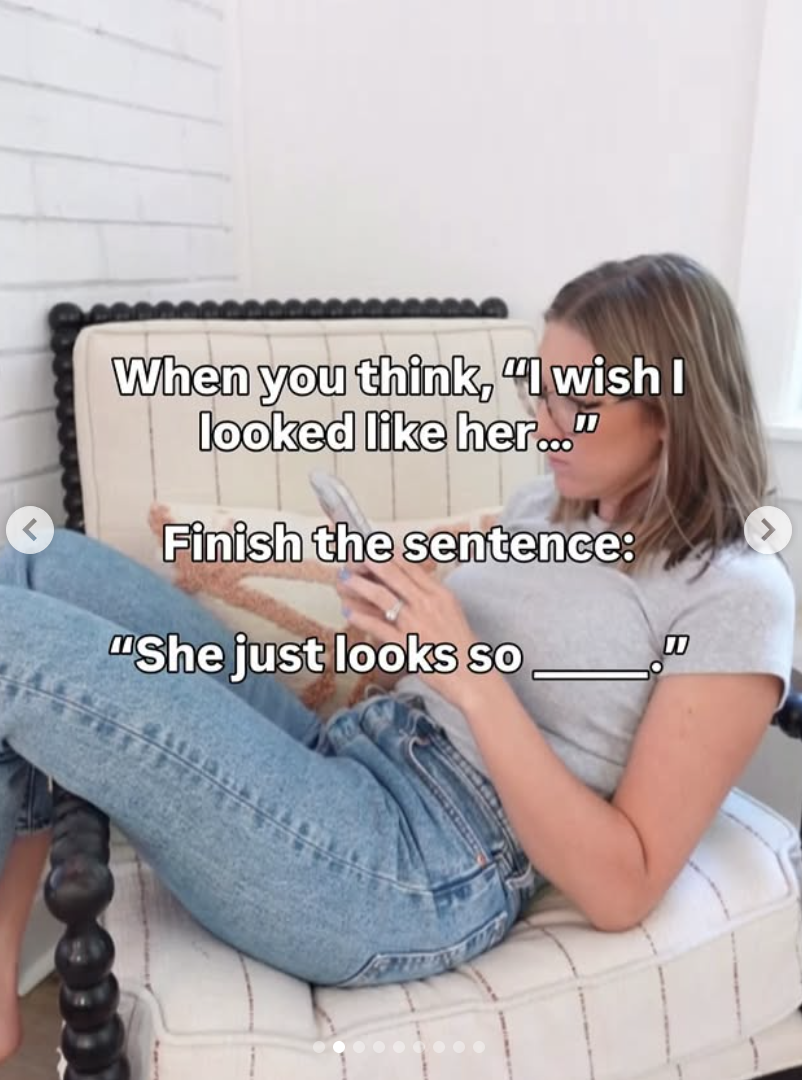
I put it out into the world across a few platforms, and 379 of you were generous enough to answer. (THANK YOU!!)
I've sorted through the responses.
And as I was trying to figure out which answer had won, something unexpected happened. The answers looked different on the surface, but the more I read, the more they started sounding like they were all pointing to the same thing.
#5 Put together
This was my personal response. There's something about a woman who looks like her whole life has been assembled with care, like she woke up, consulted a plan, and the plan is working. The general vibe of someone who has never once left the house in sweats without makeup.
I will fully admit this one hits a core insecurity of mine, which makes sense why this would be my answer. I do not always feel put together, especially since becoming a mom. I'll catch myself looking at these women — these effortlessly, infuriatingly assembled women — and think, she just has "it."
Whatever "it" is.
As if looking put together means feeling put together, which my brain has decided it does, although my therapist brain knows that's not true.
#4 Thin
Fair. This one wasn't shocking. What was surprising is that it landed in fourth place instead of first. Though, I'm dying to know what would happen if we followed up with everyone who said thin and asked, "Okay, and if you were thin, you'd feel ______?"
- Would you feel happier?
- More attractive?
- More relaxed?
- More worthy?
- More confident?
Because I have a hunch the real answer isn't hiding in the word "thin" at all. It's hiding one layer under it.
Again, back to my question, what are we really after? 👀
#3 Fit
I smiled when I saw this one outrank thin. It made me wonder if we're slowly changing what we admire. Maybe we're not just admiring just a body shape anymore. Maybe we're admiring what that body seems capable of?? Like...
- The ability to chase your kids around the backyard.
- Throw your suitcase into the overhead bin.
- Walk all day on vacation without your body holding you back.
- Climb a flight of stairs without getting winded.
- Carry the groceries in one trip.
I love that.
Of course, if we're being honest, aesthetics are probably woven into this answer too. I don't think wanting to feel attractive is the problem. I just don't think it's the whole story.
Which brings me right back to my now slightly annoying follow-up question: Okay... and if you were fit, then what?
#2 Happy/FUN
Oh, this one landed somewhere tender in me, because I remember this feeling exactly. I would look around at other women, utterly convinced they had cracked some code I hadn't even found the door to yet.
They're so happy.
They're so fun.
Which of course ended with: what is wrong with me? Why is it so hard for me to be like that?
When I kept asking myself that same annoying question: Okay... and if you were thin, then what? This was the answer that kept bubbling up.
I'd be happier.
I'd have more fun.
I'd enjoy life more.
I'd finally just... live.
Oh.
Which, of course, we want that. We get one life. It's hard to watch another year go by feeling like you're waiting for it to begin. But here's the part I couldn't stop thinking about...
If happiness is actually what we're after, why do we spend almost all of our energy chasing the thing we hope will make us happy, instead of chasing happiness itself?
Looking back, I always had spreadsheets for calories. I never had a single plan for having more fun.
Then I got to the answer that received more votes than any of the others.
And suddenly the whole list made sense.
Put together.
Thin.
Fit.
Happy.
I don't actually think they were four different answers. I think they were all pointing toward the same thing.
👇
#1 Confident
She just looks so confident.
Are you surprised? Or are you nodding along, thinking, yeah, obviously, of course it's that one? It makes complete sense to me, because it's what I hear from my clients all the time.
- I want to lose weight so I'll feel more confident.
- I want to get stronger so I'll feel more confident.
- I want to dress better so I'll feel more confident.
The good news about confidence is, regardless of dress size or bank account or relationship status, anyone can have it. And yet so many of us feel like it's the most unreachable thing on the list. Which tells me we've got some seriously tangled-up ideas about what confidence actually is.
How would you define confidence?
What does that word even mean to you? When you imagine yourself being more confident, what do you have more of?
- Ease?
- Self-Assurance?
- Trust?
I find this maddeningly hard to pin down. It's one of those words we all use constantly and could all, if pressed, only half-define. So let's pop on over to our trusty friend Psychology Today and see what the big dog professionals have to say.
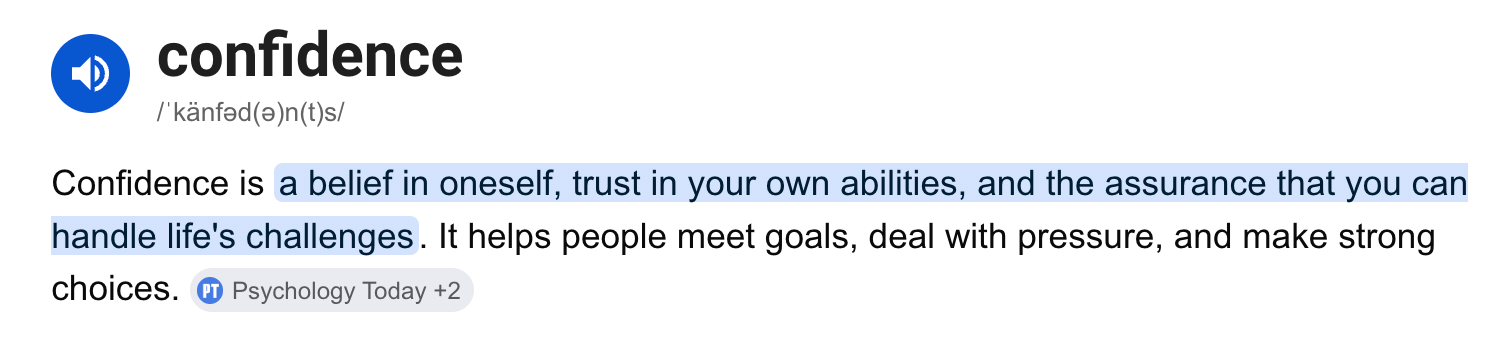
Ehh that definition gives me... NOTHING.
I mean, it's a fine definition, but my problem with it is that its so broad. Sure, in some areas of my life, I trust myself completely.
- I trust myself to make a mean box of mac n' cheese.
- I trust myself to take care of my daughter.
- I trust myself to help my clients quiet their food noise.
But everywhere? HA. Absolutely not.
So by that definition... am I confident, or am I not?
Well. I'm about to say the most on-brand therapist thing I could say: I believe both things can be true.
However (!!) I also think we've all absorbed some myths about confidence that are making it significantly harder to actually feel confident, even when we technically qualify. So before we get anywhere near the part where I try to help you build more of it, let's clear out the myths first.
Four Things You've Been Told About Confidence That Are Just... Not True
👇👇👇
Myth #1: Confidence means liking everything about yourself.
It doesn't, and thank god, because that bar is impossible and also kind of insane. Confidence isn't loving your arms in a sleeveless dress or feeling neutral about your under-eye situation at 6am. It's being able to think ugh, I hate this photo and just move on with your day, instead of spiraling into what is wrong with me.
Myth #2: Confident people don't care what anyone thinks.
Nearly everyone cares, including the most confident person you know!! She still feels her stomach drop a little when someone doesn't text back, or when she catches a weird look across the room. The difference is how she responds to that. Caring what someone thinks and needing their approval to feel okay are two very different animals, and most of us have spent years confusing them for the same one.
Myth #3: Confidence is something you either have or you don't.
No, and you know how I know this? Because you can absolutely crush a client presentation, negotiate your salary without blinking, run a household with no problem and then completely fall apart trying on jeans in a Zara fitting room with bad lighting and no chair.
The same thing goes for other people. Confidence is contextual. You are already confident in some area of your life. You're just hyper-focused on the areas where you don't feel it, and generalizing that to mean everywhere.
Myth #4: Confidence comes after you lose weight.
This is the one with its teeth in almost every client I work with. We all know this story. When I lose weight, then I'll feel more confident.
- When the number on the scale moves...
- When the jeans fit the way they used to...
- When the body finally looks like the "after" photo...
And sure, maybe a version of confidence does show up when you get there. But it's not very long-lasting, is it? Because if you're banking on weight loss alone to hand you confidence, what happens the second your boobs feel saggy, or your butt isn't plump enough, or your hair is too flat that day?
The goalposts just move again. The bar never stops. There's always a new body part waiting to be the reason you're not allowed to feel good yet. 💔
So, how do we actually become HER? The confident one. The one who feels like she's finally living inside her own life instead of watching it from the doorway?
Here's where I could hand you five steps. Step one: reframe your inner dialogue. Step two: practice affirmations in the mirror. You've read that article. I've written that article. And if we're being honest with each other, it's never once actually worked, has it?
(No!)
It didn't work because we skipped two things.
- Nobody ever gave us a definition of confidence worth chasing, so we've been running at a moving target with no idea what the finish line even looks like.
- There are two completely different kinds of confidence, and almost every one of us has spent years building the fragile one.
So below, you're getting the definition I finally landed on after years of doing this work with women. The difference between the two kinds of confidence, and why one of them evaporates the second someone looks at you funny. And then the eight things Kasey and I actually use, four for when you're spiraling in real time and four for the long game.
Plus the one thing that is very much not on that list. You already know what it is. Stay for it anyway.
📌 Psst — The Good Stuff Is Below
Upgrading to paid is basically the cheat code for everything we teach. For less than the price of your Netflix subscription, you get:
- A Private Podcast — Every Monday, your therapist and dietitian best friends talk you off the ledge about food, mindset, and actually feeling good in your life
- Easy Recipes — We don't have time to spend all day in the kitchen, and I'm guessing you don't either. Simple recipes anyone can make.
- Meal Plans — A done-for-you monthly meal plan + grocery list, dropped every first Friday so you never have to think "what's for dinner" again
- Resources, Tools, and Challenges — The exact tools a therapist and a dietitian use in real life to make healthy living feel simple, not like a full-time job
- Community — A room virtual room full of women rebuilding a healthier, more peaceful life right alongside you so you're not doing this alone
- Plus every podcast, recipe, meal plan, and challenge we've ever made, unlocked the second you join
These are the insights and perspectives I usually only spill to my higher level coaching clients. Come on, let’s get into it. 👇